Hybrid Solar Inverter Price in Pakistan: 2026 Costs, Sizing & Engineering Comparison
The standalone hybrid solar inverter price in pakistan currently ranges between PKR 95,000 and PKR 550,000+, depending on capacity class (3kW to 12kW), phase configuration (single-phase vs. three-phase), and weatherproofing (IP21 indoor vs. IP65 outdoor). Entry-level 3.6kW to 4.2kW single-phase units cost between PKR 95,000 and PKR 150,000, standard 6kW residential units sell between PKR 145,000 and PKR 260,000, while premium 10kW to 12kW three-phase systems range from PKR 320,000 to PKR 520,000.
With the National Electric Power Regulatory Authority (NEPRA) revising export buyback rates under the Net Billing framework down to approximately Rs. 9.80 to Rs. 11.00 per unit, while daytime and peak-hour grid tariffs hover above PKR 45 to PKR 65 per unit, investing in a high-efficiency hybrid solar inverter has become the primary financial safeguard for Pakistani property owners. Rather than dumping valuable excess solar generation onto the grid for nominal credit, a hybrid topology stores day units in a lithium bank to eliminate night billing.
This engineering guide provides updated hardware rates across Pakistan, evaluates the best hybrid solar inverter in pakistan, analyzes the operational difference between low-voltage and high-voltage architectures, and exposes critical installation mistakes that cause premature equipment failure.
2026 Hybrid Solar Inverter Price in Pakistan by Capacity
Inverter prices fluctuate based on foreign exchange benchmarks, import customs clearance, and embedded engineering features such as dual MPPT trackers, native Battery Management System (BMS) communication, and ingress protection (IP ratings).
The table below outlines current hardware-only market pricing across major urban centers including Islamabad, Rawalpindi, Lahore, and Karachi:
| Inverter Capacity | Phase Type | Typical Price Range (PKR) | Ingress Rating | Recommended Property Profile & Peak Load |
| 3.2 kW – 3.6 kW | Single-Phase | PKR 95,000 – PKR 140,000 | IP21 / IP54 | Small homes, apartments: 1 refrigerator, lights, fans, zero heavy cooling |
| 4.2 kW – 6.0 kW | Single-Phase | PKR 145,000 – PKR 260,000 | IP21 / IP65 | 5 to 10 Marla villas: 1 inverter AC (1.5 Ton), refrigerator, water pump |
| 8.0 kW – 8.2 kW | Single / Split-Phase | PKR 260,000 – PKR 360,000 | IP65 | 10 Marla to 1 Kanal homes: Two 1.5 Ton ACs, refrigeration, daytime loads |
| 10.0 kW – 12.0 kW | Three-Phase | PKR 320,000 – PKR 520,000 | IP65 / IP66 | 1 Kanal+ villas, corporate commercial offices, private clinics, light manufacturing |
| 15.0 kW – 30.0 kW | Three-Phase | PKR 550,000 – PKR 1,100,000 | IP66 | Multi-story commercial complexes, bakeries, flour mills, hospitals |
Note: These figures reflect hardware procurement estimates. Final turnkey system budgets include certified copper cabling, Class-2 surge protection devices (SPDs), zero-drill mounting structures, and net metering bi-directional meter licensing.
How Does a Hybrid Solar Inverter Work? (Hybrid vs. Off-Grid vs. On-Grid)
A hybrid solar inverter acts as the central brain of a modern solar setup. It combines the functionality of an on-grid string inverter (synchronizing directly with the WAPDA grid for bidirectional export) with an intelligent battery charge controller and bidirectional power converter.
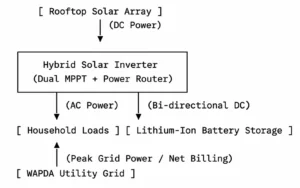
Key Differences to Know:
-
On-Grid Inverters: Shut down entirely during a grid blackout (anti-islanding safety) to prevent electrocuting line workers. They offer zero backup during load shedding.
-
Off-Grid Inverters: Operate completely isolated from the grid or treat the grid strictly as an emergency generator input. They cannot export units to WAPDA.
-
Hybrid Inverters: Seamlessly balance solar, battery storage, and grid input simultaneously. They provide uninterrupted power supply (UPS transfer speeds under 10–20 milliseconds) while maintaining the capability to export excess power under NEPRA Net Billing rules.
Can You Run a Hybrid Solar Inverter Without Battery?
Yes. Many modern hybrid units support operation as a solar inverter without battery. In this mode, the inverter blends direct solar generation with incoming grid electricity during daylight hours to power connected loads. However, if a daytime grid outage occurs on a unit without storage, the inverter will instantly trip unless an active, synchronized battery bank is connected to stabilize the DC busbar voltage.
Ranking the Best Hybrid Solar Inverter in Pakistan
Selecting the best hybrid solar inverter in pakistan depends on your budget, whether your property has a three-phase WAPDA connection, and whether the inverter will be installed indoors or exposed to outdoor summer temperatures.
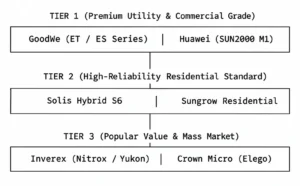
1. GoodWe ET & ES Series (Premium Commercial & Residential Standard)
-
Ingress Rating: IP65 / IP66 (Complete outdoor water and dust proofing)
-
Battery Architecture: High-Voltage (HV) on ET models; Low-Voltage (48V) on ES models
-
Engineering Verdict: Exceptionally reliable three-phase synchronization. Natural convection cooling eliminates loud fans, making it ideal for residential installations where silent operation is required. Native CAN/RS485 communication integrates cleanly with leading lithium battery protocols.
2. Inverex Nitrox Series (Broad Market Availability & Local Support)
-
Ingress Rating: IP65
-
Battery Architecture: 48V Low-Voltage up to 12kW single/three-phase
-
Engineering Verdict: One of the most widely deployed inverters across Pakistan with established service centers in Lahore, Karachi, and Rawalpindi. Features an intuitive colored touch LCD and supports paralleling up to 16 units for commercial scaling.
3. Solis Hybrid S6 Series
-
Ingress Rating: IP66
-
Switching Speed: Uninterruptible power supply (UPS) grade $<10\text{ms}$ transfer
-
Engineering Verdict: Superior surge tolerance for motor-driven appliances (water pumps, compressors, inverter air conditioners). Handles high DC input oversizing (up to 150–160%), allowing homeowners to install extra panels to capture weak morning and evening solar irradiance.
4. Crown Micro (Elego & Yorker Series)
-
Ingress Rating: IP21 (Indoor installation mandatory)
-
Target Segment: Budget-conscious 5 Marla and 10 Marla residential properties
-
Engineering Verdict: Capable baseline performance for single-phase installations on tight capital budgets. Requires a clean, dust-free indoor utility room to avoid thermal throttling during peak July–August ambient temperatures.
Why Cheap Installations Fail: Three Technical Oversights in Pakistan
Hardware accounts for only half of your system’s operational lifespan. In our technical audits of stalled and failing systems across Punjab and Sindh, premature inverter board burnouts and continuous system tripping stem from three common contractor mistakes:
1. Inadequate Solar Earthing and Surge Protection
WAPDA feeder lines across Pakistan experience extreme voltage sags and lightning surges during monsoon months. Cheap contractors routinely skip dedicated solar earthing pits or combine DC structural ground with AC utility ground on a single rusty rod.
-
Engineering Standard: A reliable installation requires dual independent earth pits: one dedicated pit for DC surge arresters (SPD Type II) and panel frames yielding ground resistance below $5\,\Omega$, and an isolated pit for the AC distribution box.
2. Roof Slab Damage from Mechanical Anchor Drilling
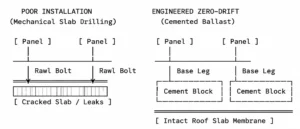
Most local installers mechanically bolt lightweight steel frames directly into the concrete roof slab using rawl bolts. This punctures the water-barrier membrane, resulting in severe ceiling leakage and structural degradation during torrential rains.
-
Engineering Standard: Engineered systems utilize heavy ballasted concrete blocks paired with a non-penetrating zero-drill solar panel stand. This anchors the system against winds exceeding $140\text{ km/h}$ while protecting the roof slab permanently.
3. Mismatched Battery Chemistries (Lead-Acid vs. LiFePO4)
Pairing a modern hybrid inverter with tubular lead-acid batteries reduces efficiency to 70–75% and degrades the battery bank within 18–24 months due to deep discharge stress. Lithium Iron Phosphate ($\text{LiFePO}_4$) batteries deliver 6,000+ duty cycles at 90% Depth of Discharge (DoD) and communicate directly with the inverter’s BMS to prevent thermal runaway.
Sizing Your Hybrid Inverter: A Real-World Appliance Matrix
Selecting the proper inverter capacity requires calculating simultaneous continuous load alongside high-inductive starting currents from compressors and pumps:
PIXXX
-
4 kW to 6 kW System: Suitable for running one 1.5-ton inverter air conditioner, a refrigerator, water dispenser, and household lighting.
-
10 kW to 12 kW System: Capable of powering two to three 1.5-ton inverter air conditioners simultaneously while operating commercial refrigeration or high-pressure water pumps.
Frequently Asked Questions
What is the average hybrid solar inverter price in Pakistan in 2026?
A certified hybrid solar inverter typically costs between PKR 95,000 for a 3.2kW residential model and PKR 450,000 to PKR 520,000 for a three-phase 10kW to 12kW tier-1 unit. Total cost varies based on IP rating, brand, and warranty provisions.
Can a hybrid solar inverter work without a battery connected?
Yes. Many modern hybrid inverters can blend solar and WAPDA grid power during daylight hours without storage. However, if the grid fails while no battery is installed, the inverter will shut down immediately to protect internal circuits from load fluctuations.
Why does my hybrid solar inverter trip repeatedly in the afternoon?
Afternoon inverter tripping is commonly caused by high grid voltage on local distribution transformers (exceeding 255V–260V as neighborhood solar generation peaks), undersized DC wiring causing thermal overcurrent, or poor solar earthing triggering a ground-fault detection alert (F24/F35 fault codes).
What is the lifespan of a Tier-1 hybrid solar inverter?
Quality hybrid inverters from manufacturers like GoodWe, Huawei, and Solis carry a design lifespan of 10 to 15 years, backed by standard 5-year manufacturer replacement warranties. Operating them in well-ventilated, shaded spaces away from direct rain and dust ensures maximum service longevity.